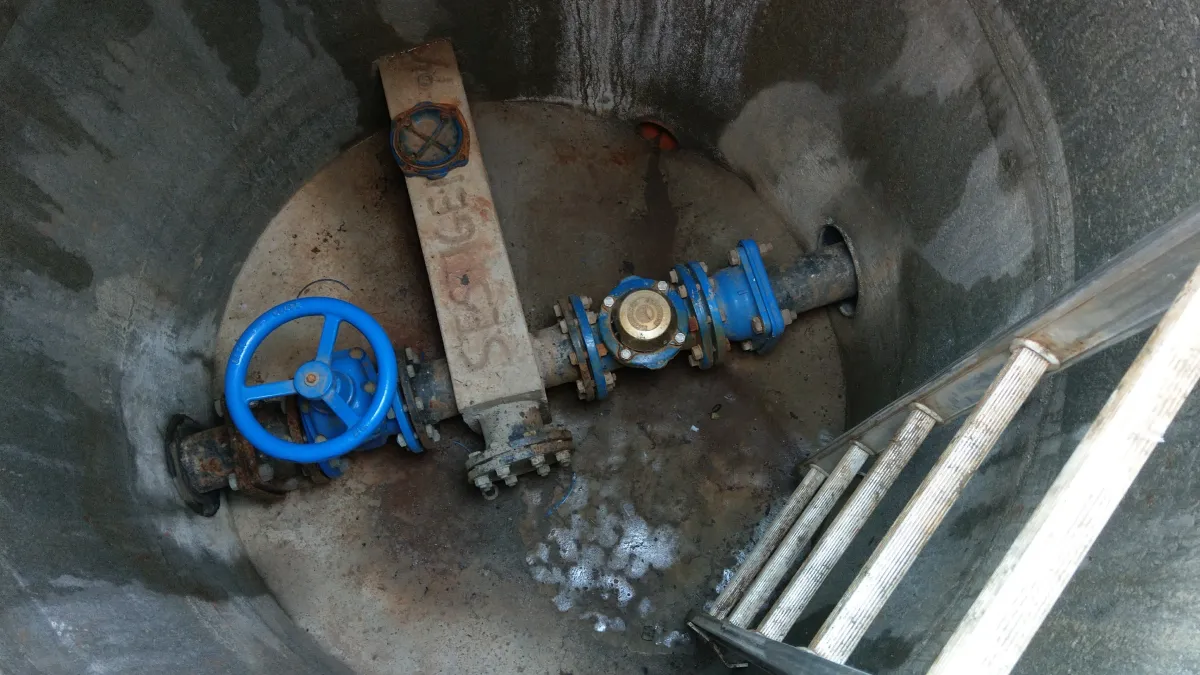
The IWA water balance explained
A practical guide to the IWA water balance: its components, data sources and the checks needed for a reliable leakage estimate.


Industry · 19 October 2026
Remote-read meters deliver millions of readings a year, and some of them are wrong. VEE is the discipline that decides which readings can be used, which must be estimated, and how a correction is recorded so it can be defended later.
A water meter reports 1,842 m³ at 03:00 and 1,849 m³ at 04:00. For a household that is 7,000 litres in an hour. Is it a burst pipe, a meter whose clock drifted so two days of use landed in one hour, or a reading that arrived twice with different timestamps?
Three more cases from everyday operation:
Every meter reading is a claim, not a fact. VEE, short for validation, estimation and editing, is the set of rules that turns claims into data that can be billed, analysed and defended. The term comes from electricity metering, where it has been a standard part of meter data management for twenty years. It applies just as much to water, heat and gas, and it now appears in most tenders for a meter data platform.
The European rules for metering data are written for electricity, but they make a distinction that every utility should copy.
Directive (EU) 2019/944, Article 20(a), separates two kinds of data. Validated historical consumption data must be made available to final customers on request. Non-validated near real-time data may also be made available, through a standardised interface, to support demand response and other services. The directive does not say how validation is done. It says that the two kinds of data must be told apart.
Implementing Regulation (EU) 2023/1162 sets the interoperability rules for access to that data. Its definition of validated historical metering data is worth reading twice: data collected from a meter, “or completed with substitute values that are determined otherwise in case of meter unavailability”. In other words, estimation is part of validated data by definition, as long as the substitute values are determined by a rule and can be told apart from measured ones.
IEC 61968-9:2024, the Common Information Model (CIM) interface standard for meter reading and control, gives the data model. A meter reading in a CIM message carries a reading quality alongside the value: whether it was measured, estimated or edited, and why. The standard is written primarily for electricity distribution and states that it can be applied to gas and water metering as well.
Together these say three things. Keep validated and non-validated data apart. Allow substitute values, but mark them. Carry the quality of a reading with the reading, not in a separate spreadsheet.
Validation runs when a reading arrives. It does not change the value. It attaches a status, and if the reading fails, a reason. The checks that matter in practice:
| Check | What it catches |
|---|---|
| Future timestamp | Meter clock ahead of real time; a small tolerance is normal |
| Too old or out of order | A reading that arrives after later ones have already been processed |
| Duplicate timestamp | The same reading delivered twice, or two readings claiming the same instant |
| Spike or high increment | A jump that exceeds what the meter size and recent history make plausible |
| Absolute magnitude | A value the register cannot physically hold |
| Unit mismatch | A device reporting litres into a meter configured for cubic metres |
| Stuck register | No change over a period in which consumption is expected |
| Gap | No reading in a window where one is due, for example a billing date |
| Decreasing register | A register that counts backwards |
| Register versus interval | Hourly consumption values that do not add up to the index the meter reports |
Two of these need judgment rather than a rule.
A decreasing register is not always an error. Backflow through a meter is real, and a rule that rejects every decrease will throw away genuine data. The better pattern is to flag the reading, keep it, and let the pattern over several readings decide.
A spike depends on the meter. A 7,000-litre hour is impossible for a DN15 household meter and routine for a DN100 inlet. Thresholds have to follow the meter size and, ideally, the meter’s own history. One fixed number for all meters produces either false alarms on large meters or blind spots on small ones.
Two design rules separate good validation from decorative validation:
Estimation produces a value where none was measured. The common need is a billing instant: the end of the month, the day the tariff changed, the day the tenant moved out. The meter reported the day before and the day after, and the bill needs the value in between.
The usual strategies, in increasing order of ambition:
Which strategy is right depends on the use. For a water bill, interpolation between two actual readings is usually fair to both sides. For a leak alarm, no estimate should be used at all.
Three rules apply whatever the strategy. The estimate is flagged as an estimate wherever it appears, including on the invoice and in the API. It is replaced by the actual value if one arrives later, and the replacement is recorded. And it is reversible: an estimate that turns out wrong can be withdrawn without hand-editing a database.
Note the difference between estimating a reading and estimating a derived figure. A zone water balance that apportions a stale inlet reading across days is estimating a volume, not a meter value. It should be flagged in the same way, but it does not need to write anything back to the meter’s history.
Editing is the part most systems get wrong, because it looks harmless. An operator opens a chart, sees a wrong point, and deletes it. The data is now cleaner, and the evidence that there was ever a problem is gone.
The rules for a defensible edit:
The last point is where the quiet failures live. Totals are often calculated once, at night, and never rebuilt. A correction made a week later sits in the reading table while every report built from the totals stays wrong.
A platform typically serves readings to a dozen consumers: billing, alarms, consumption analyses, water loss calculations, customer portals, a public API, exports to third parties. Each of them has to answer the same question: which readings count?
If each consumer answers it separately, they will answer it differently. Alarms will ignore readings that the public API happily delivers. The water balance will include a rejected spike that the chart hides. A customer will see one number in the portal and a different one through the API, because one applied the meter’s offset and the other did not.
The fix is organisational as much as technical: one rule for what a usable reading is, written down, and applied by every consumer. The CIM reading quality is a reasonable place to anchor that rule, because it carries the status with the reading rather than relying on each consumer to remember the filter.
If VEE appears in your tender, or you want to know whether the platform you have already does it, these questions separate the answers:
A supplier who can show the audit trail for one edited reading, end to end, has usually answered most of the other questions as well.
Divako validates every reading on arrival and stores the outcome with the reading: a validity flag and the reason a reading was rejected, visible to the operator and carried into the data that leaves the platform. Readings from water, heat, electricity and gas meters go through the same checks regardless of which network delivered them.
Estimation and stipulation of billing readings live in Divako Settlement. It proposes a substitute value from the strategies above, records the source and the reason, holds billing-relevant corrections for approval, and can roll a stipulated value back when the actual reading arrives.
The same validity status feeds water loss management, where a rejected inlet reading matters more than most: in a top-down water balance, customer metering inaccuracies and data-handling errors are counted as apparent losses, and every one of them shifts the leakage estimate.
A practical guide to the IWA water balance: its components, data sources and the checks needed for a reliable leakage estimate.
A worked ILI calculation: build the water balance, find the four UARL inputs and check the result with a practical network example.
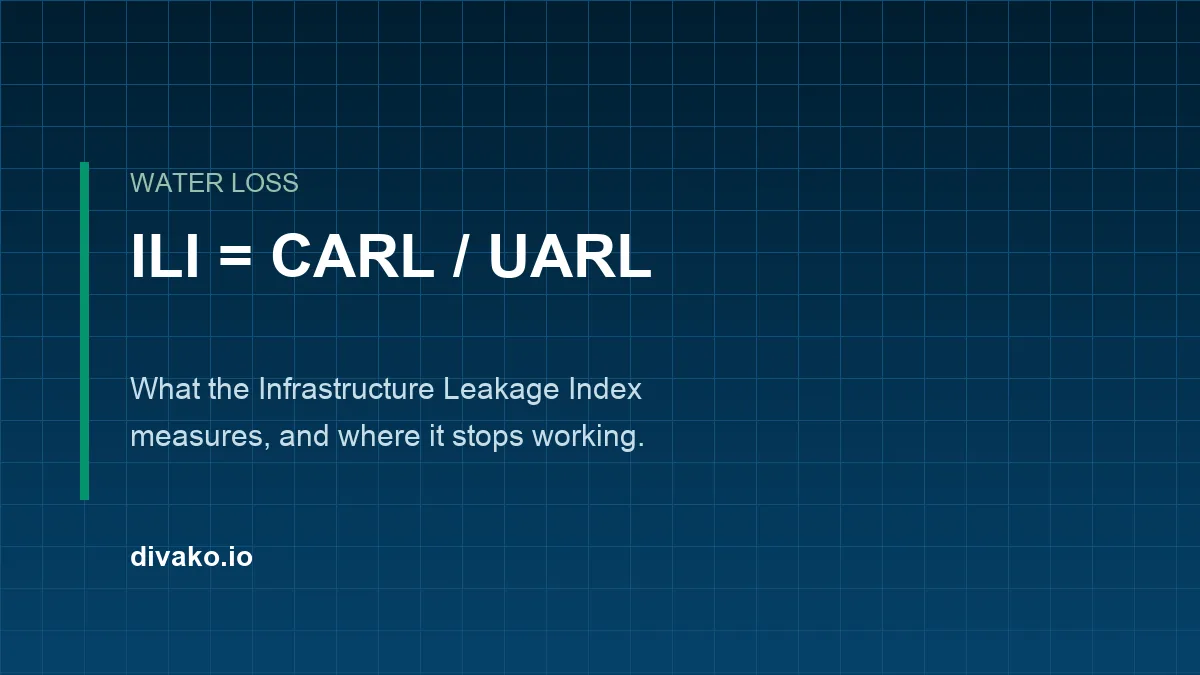
The Drinking Water Directive names ILI as the method for assessing leakage. What the index is, how UARL is calculated, a worked example, and the systems where it does not apply.
Your meter data
Tell us which meters you read and where the readings end up: billing, alarms, reports or an API. In about 30 minutes we’ll walk through how each reading is validated, flagged and corrected on Divako.