
News · 16 June 2026
Stavanger chooses data freedom for smart water metering.
Norway's energy capital has signed a framework agreement to bring its water network onto Divako – remote-read ultrasonic meters running on an open, vendor-neutral platform. The headline here isn't the hardware. It's that Stavanger keeps ownership of its data and stays free to pick any meter, on any network, for years to come.
From oil capital to digital showcase
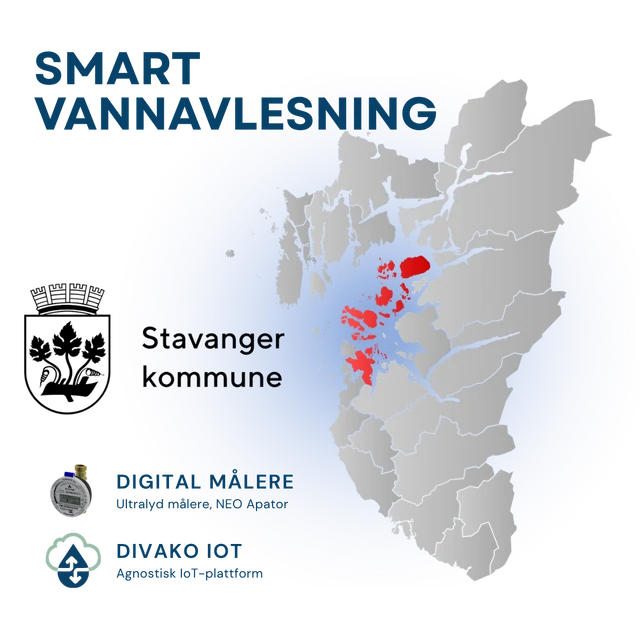
Stavanger has spent the last decade turning an oil-and-gas legacy into a reputation for clean technology – an EU “lighthouse city” for smart transport and energy. Extending that to water is a natural next step, and a demanding one: a coastal region of dense urban cores, scattered rural buildings and difficult topology to cover.
The groundwork was already laid. Since 2020, every new or renovated building in Stavanger has had to carry a municipal water meter. The new framework agreement now puts those readings – and the network behind them – on a single platform. Phase one replaces around 3,000 ageing mechanical meters and rolls out roughly 2,300 new smart units to private and commercial customers, with the agreement structured to scale toward more than 50,000 homes across the Stavanger region.
Data freedom, by design
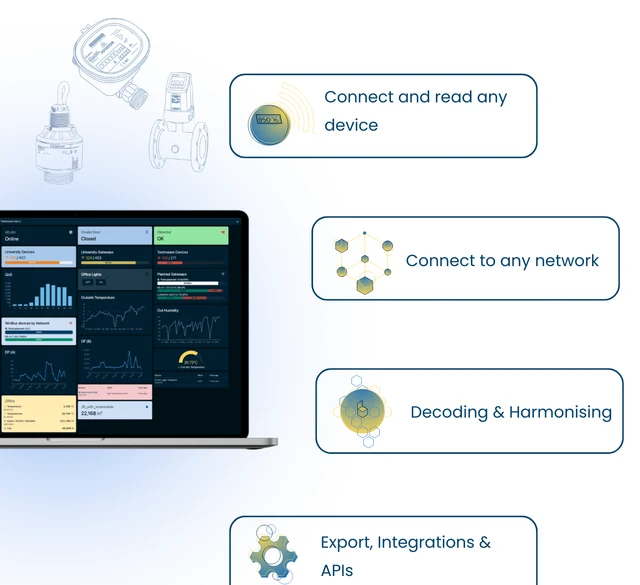
The decision that defines this project is what Stavanger chose not to do: lock itself into a single manufacturer’s closed stack. Instead the municipality picked an agnostic platform – Divako collects, decodes and harmonises readings no matter whose meter sits underneath. The data stays the municipality’s own, and the next hardware choice stays open.
That isn’t a promise on a slide. Roughly 70% of the meters Divako manages across Norway today come from manufacturers other than any single preferred brand – Kamstrup, Axioma, Sensus and Krohne among them. A vendor-neutral platform is what lets a municipality bring in whatever a procurement delivers and still see it all in one place.
Meters built for the coast and the long run
The rollout pairs Apator Ultrimis NEO ultrasonic meters for homes and businesses with Diehl HYDRUS 2.0 BULK units for the larger dimensions on the trunk network. Ultrasonic measurement has no moving parts to wear out, so accuracy holds across a service life of up to sixteen years – and the NEO meters carry LoRaWAN Relay support to reach the awkward basements and outbuildings that coastal infrastructure is full of. Bulk meters connect through Lobaro gateways where the dimensions demand it.
From reading to acting
A meter that reads itself is only the start. On top of the data sits alarm management – alerts for leaks and pipe bursts, backflow, dry or tampered meters, and frost risk – so problems surface the day they begin rather than at the next billing cycle. Administration works from a live picture of the whole network instead of a once-a-year snapshot, residents pay for what they actually use, and the abnormal consumption that hints at a hidden leak gets flagged early.
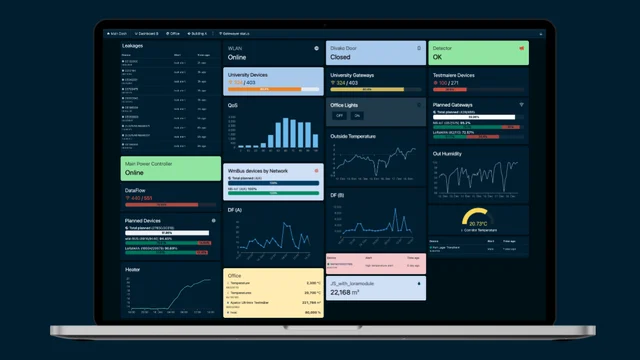
"An open platform means Stavanger owns its data and its choices – we connect the meters, decode the network and keep every option on the table for what comes next." - Divako technology team
The bigger picture
Stavanger joins a growing list of Norwegian utilities reading their water networks remotely on Divako, alongside Oslo VAV, Asker Kommune and the shared rollout across Hamar and Ringsaker. The pattern repeats: choose a multi-protocol, vendor-neutral platform, bring in whatever meter the procurement delivers, and turn raw sensor data into something the water utility can act on – without signing away the data in the process.
Talk to us about a rollout See the Hamar & Ringsaker rollout →
Same shape, your region
Smart metering without the vendor lock-in.
If you are shaping a remote-metering procurement and want to keep your data and your hardware choices open, we will walk you through the architecture and the trade-offs, no obligations.